
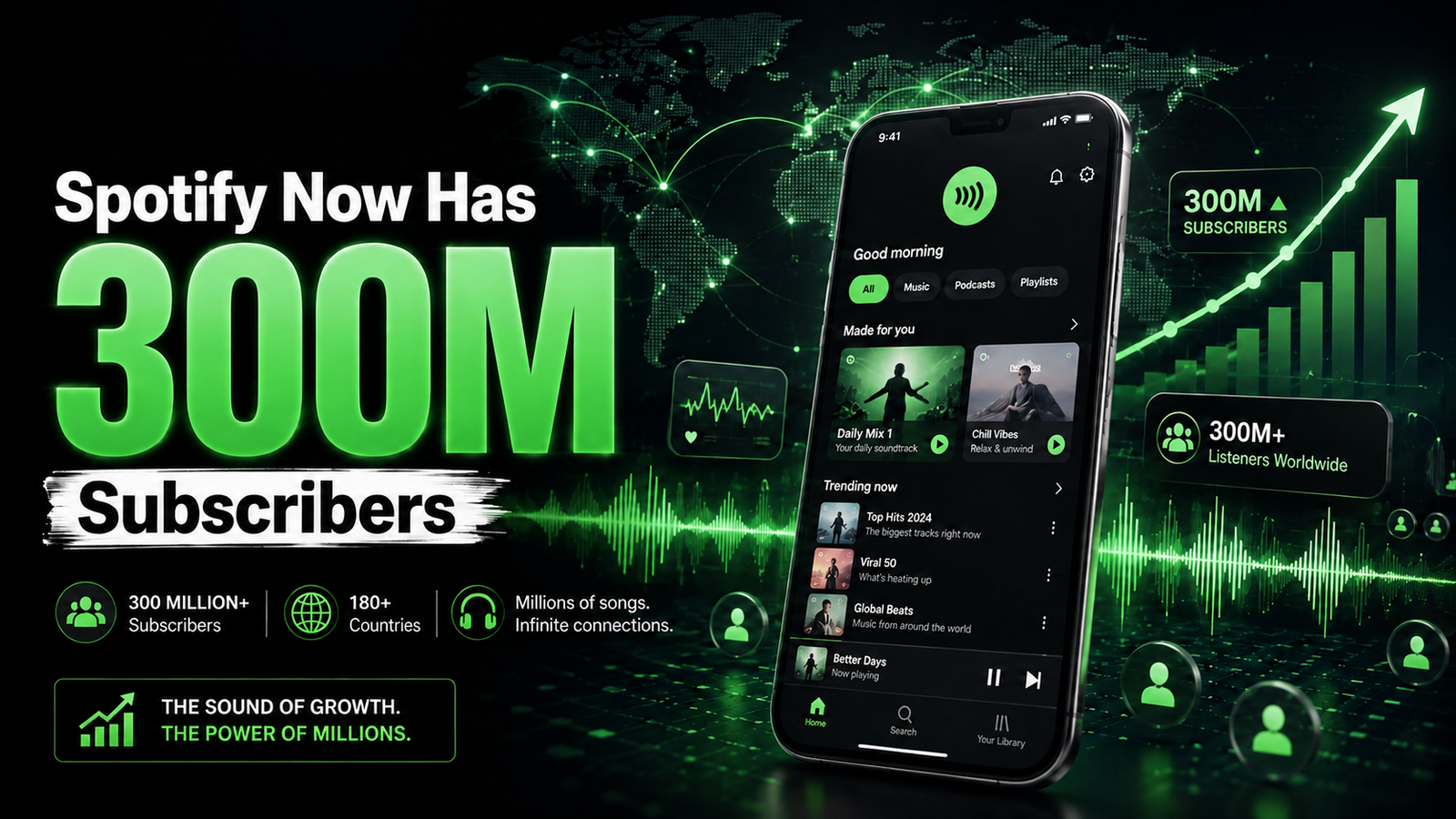
Spotify has officially reached 300 million Premium subscribers, marking a major milestone for the world’s largest audio-streaming subscription service. The company announced the achievement alongside its second-quarter 2026 financial results on August 4. Premium subscriptions increased 9% compared with the same period last year.
Spotify now has 777 million monthly active users worldwide. That figure includes both paying subscribers and people using its advertising-supported service. The latest results show that Spotify continues converting free listeners into paying customers. However, growing expenses around artificial intelligence could pressure future profits.
Spotify Added Seven Million Subscribers in One Quarter
Spotify reported 293 million Premium subscribers during the first quarter of 2026. The number increased to 300 million by the end of the second quarter.
Therefore, Spotify added approximately seven million paying subscribers within three months. Monthly active users also increased from 761 million to 777 million during the quarter. This represents a gain of 16 million users.
The growth came from several regions, showing that Spotify’s expansion is not limited to one major market.
Reaching 300 million subscribers places Spotify among a small group of global streaming platforms with such a large paying audience.
Revenue Increased as Spotify’s Margins Improved
Spotify generated approximately €4.8 billion in total revenue during the second quarter. Revenue increased 14% from the previous year. The company’s gross margin reached a record 33.4%, improving by around 1.93 percentage points year over year.
Spotify also reported €655 million in operating income. These figures suggest that its subscription business is becoming more financially efficient. Premium subscription revenue grew faster than Spotify’s advertising business. Advertising-supported revenue increased only 1% compared with the previous year.
By comparison, Premium subscription revenue increased 15%. This difference highlights the growing importance of paying subscribers to Spotify’s business model.
AI and Personalization Are Driving Spotify’s Strategy
Spotify is expanding beyond traditional music streaming through artificial intelligence, audiobooks, podcasts, and personalized listening tools. Its newer features include Talk to Spotify, which lets eligible users interact with the service using text or voice commands.
Spotify has also introduced Personal Podcasts, Running Mode, an expanded AI DJ, and Studio by Spotify Labs. The company said its DJ feature is expanding into four additional languages and more than 75 markets.
According to Spotify, around 25% of its users have already interacted with its AI-powered features. The company is also developing tools for fan-made covers and remixes through licensing agreements with music rights holders. These investments could help Spotify offer experiences that competing music services cannot easily reproduce.
However, the company expects marketing and AI investments to add roughly €200 million in operating expenses during 2026.
Spotify Wants to Become More Than a Music App
Spotify’s long-term strategy involves becoming a broader platform for music, podcasts, audiobooks, creators, and fan experiences.
The company now offers more than 100 million music tracks, seven million podcast titles, and 700,000 audiobooks in supported markets.
It is also testing services that connect subscribers directly with artists. Reserved by Spotify allows selected Premium subscribers to purchase concert tickets before general sales begin.
Spotify said nearly 100,000 tickets have been reserved through the program since its United States launch with Live Nation. These services could make Premium subscriptions more valuable while creating new relationships between Spotify, artists, and listeners.
What Comes Next for Spotify?
Spotify expects to reach 305 million Premium subscribers during the third quarter of 2026. That would represent another five million paying users. The company also forecasts 788 million monthly active users and approximately €5 billion in quarterly revenue.
However, its user forecast came below some analyst expectations. Increased AI and marketing expenses could also limit near-term profit growth. Spotify must now balance rapid product development with the need to maintain stronger margins.
Why This Milestone Matters
Reaching 300 million Premium subscribers shows that people remain willing to pay for convenient and personalized audio services. It also gives Spotify a large recurring-revenue base for funding new products across music, podcasts, audiobooks, and artificial intelligence.
For listeners, this growth could lead to more personalized features and expanded content choices. For artists and creators, Spotify’s scale offers wider distribution. However, debates around royalties, AI content, and platform control will likely continue.
Spotify’s next challenge is no longer proving that it can attract users. The company must prove it can turn its massive audience into sustainable growth.



[9816]MK88 Login Chính Thức | Tải App APK Và Hướng Dẫn Chơi Baccarat,mk88 cung cấp link vào chính thức cùng hướng dẫn luật chơi tài xỉu chi tiết. Trải nghiệm nhà cái nạp rút nhanh chóng và an toàn. Truy cập để nhận ưu đãi ngay! visit: mk88
[7984]mwc Official Login | বিকাশ ডিপোজিট ও সেরা ক্যাসিনো বোনাস,mwc এর অফিসিয়াল প্ল্যাটফর্মে যোগ দিন। সহজেই অ্যাপ ডাউনলোড করুন এবং বিকাশ দিয়ে দ্রুত ডিপোজিট করে অনলাইন স্লট গেমের নিয়ম বুঝে খেলা শুরু করুন। এখনই জয়েন করুন। visit: mwc
[9879]Percayacuan: Login, Daftar Akun dan Slot Gacor Deposit Dana,percayacuan menyediakan akses login dan daftar akun mudah. Nikmati slot gacor deposit dana serta download apk casino terpercaya sekarang juga. visit: percayacuan
[4513]68vn | Tải app APK và đăng ký game bài đổi thưởng uy tín,68vn cung cấp link tải 68vn APK nhanh chóng, hỗ trợ đăng ký 68vn nhận code cho người mới và hướng dẫn cách nạp tiền qua momo dễ dàng. Truy cập chơi ngay! visit: 68vn
Finally found a platform that actually pays out on time. The registration process was a breeze and I was playing within minutes. kr86kr
The community here is awesome and the rewards keep coming. It is rare to find a site that cares this much about its players. Love bdn444!