
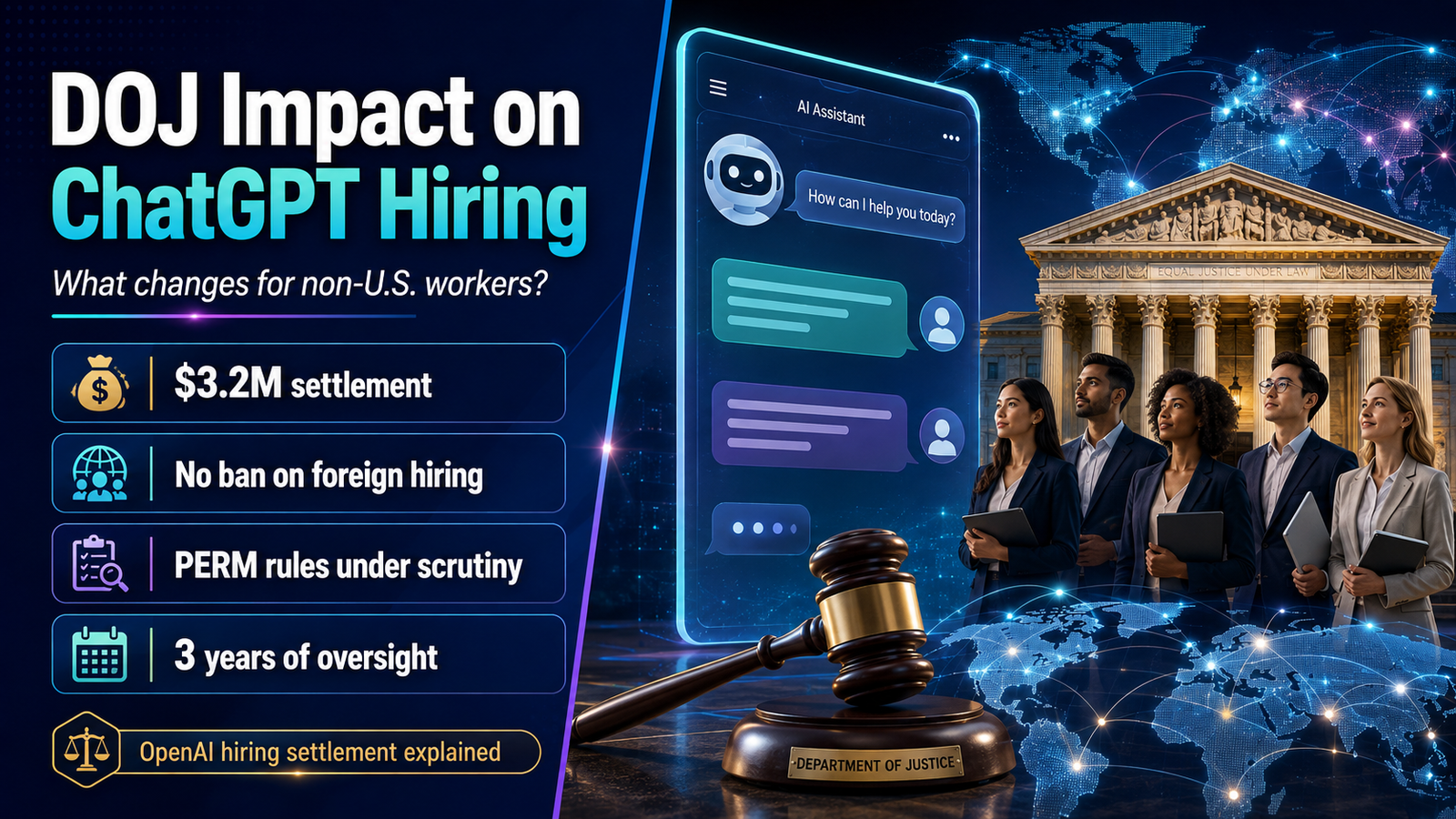
OpenAI has agreed to a $3.2 million settlement with the U.S. Department of Justice over allegations involving its hiring practices.
However, the settlement does not stop OpenAI from hiring international workers. Instead, the company must change how it advertises and manages some jobs connected to the U.S. green card process.
What Happened?
The Justice Department investigated OpenAI over recruitment practices linked to the PERM labor certification program.
PERM is commonly used when U.S. companies want to sponsor foreign employees for employment-based green cards.
As part of that process, employers must show that qualified U.S. workers had a fair opportunity to apply for the position.
According to the DOJ, some OpenAI positions involved in the process were not handled like the company’s normal job openings.
The government said certain applicants had to submit applications by mail rather than through OpenAI’s regular online hiring system.
Some positions were also reportedly missing from OpenAI’s main careers website.
Why Did the DOJ Investigate OpenAI?
The DOJ argued that these recruiting methods could make it harder for U.S. workers to discover and apply for certain positions. Federal immigration rules require companies using PERM to properly test the U.S. labor market.
This does not mean companies must hire only U.S. citizens. However, employers cannot design the recruitment process in a way that unfairly discourages qualified U.S. applicants.
OpenAI denied wrongdoing as part of the settlement. The company agreed to resolve the case without admitting that it violated the law.
OpenAI Will Pay $3.2 Million
Under the settlement, OpenAI and Statsig will pay a combined $3.2 million. Around $1.2 million will go toward civil penalties. Another $2 million will be available as potential back pay for eligible workers affected by the hiring practices.
The financial payment is only one part of the agreement. OpenAI will also face DOJ oversight of its PERM recruitment practices for the next three years.
Will OpenAI Stop Hiring Non-U.S. Citizens?
No.
The settlement does not prevent OpenAI from hiring foreign workers. It also does not stop the company from sponsoring employees for green cards.
International engineers, researchers and other professionals can still apply for OpenAI jobs if they have appropriate work authorization. OpenAI can also continue using employment-based immigration programs when legally permitted.
The biggest change is how the company must conduct recruitment for jobs connected to PERM sponsorship.
OpenAI Must Make PERM Jobs Easier to Find
OpenAI will now need to make certain sponsored positions more visible to potential applicants. PERM-related jobs must appear on the company’s external careers website.
Applicants must also have a way to apply electronically. That brings these positions closer to OpenAI’s normal hiring process.
The company will also need to properly track applications and review qualified candidates. Qualified U.S. workers cannot be rejected for reasons unrelated to the actual job requirements.
What Is the PERM Process?
PERM is one of the first major steps many employers use when sponsoring a foreign worker for a U.S. green card. Before moving forward, the employer normally has to advertise the position and test the local labor market.
The goal is to determine whether qualified U.S. workers are available for the role. If no suitable U.S. worker is available, the employer may continue the green card sponsorship process for the foreign employee.
For technology companies, PERM is particularly important. Many software engineers, researchers and technical specialists working in the U.S. eventually move from temporary visas to permanent residency through employer sponsorship.
OpenAI Will Face Three Years of Oversight
The DOJ settlement also introduces new compliance requirements. OpenAI will need to update its internal recruitment policies related to PERM positions.
Employees involved in the process must receive additional training. The company will also have to provide regular reports about its PERM recruitment activity. The monitoring period will last for three years.
That gives federal regulators greater visibility into how OpenAI handles sponsored positions.
What This Means for Foreign Tech Workers
The settlement may sound concerning for international workers, but it does not eliminate foreign hiring.
OpenAI and other technology companies can still recruit talent from outside the United States.
However, companies may become more careful when using immigration programs connected to permanent residency.
Recruiters could increase documentation and make sponsored job openings more publicly visible.
Employers may also conduct more detailed reviews of U.S. applicants before moving forward with PERM sponsorship.
That could make the green card process more competitive in some situations.
The Case Could Affect Other Tech Companies
The OpenAI settlement is also important beyond ChatGPT. Large technology companies regularly hire international engineers, developers, researchers and other specialists.
Many of those employees eventually depend on employer-sponsored immigration programs. The DOJ has previously investigated other major technology companies over similar recruitment concerns.
That means businesses using PERM may now pay even closer attention to how they advertise jobs and evaluate candidates. The OpenAI case could become another reminder that immigration sponsorship and normal recruitment practices must remain closely aligned.
Why It Matters
OpenAI is competing aggressively for some of the world’s most experienced artificial intelligence researchers and engineers.
Many of those professionals come from outside the United States. Because of that, immigration programs remain important for companies working in artificial intelligence and other advanced technologies.
The DOJ settlement does not close that path. Instead, it increases the pressure on employers to make sure U.S. workers receive a genuine opportunity to compete for positions connected to permanent residency sponsorship.
For international workers, OpenAI remains a potential employer. The difference is that the company will now operate its PERM recruitment process under much closer federal scrutiny.
Final Thoughts
OpenAI’s $3.2 million DOJ settlement is not a ban on hiring foreign workers.
The case is mainly about how the company recruited candidates while sponsoring certain employees for green cards.
OpenAI can continue hiring international talent and using legal immigration programs.
However, its PERM hiring process will now require greater transparency, stronger documentation and three years of DOJ oversight.
For the wider tech industry, the message is clear. Companies can continue competing for global talent, but immigration-related recruitment must give qualified U.S. workers a fair opportunity to apply.



[2894]12joker Official Login | Online Slot Malaysia with Fast Payouts,12joker offers a seamless gaming experience. Get the official apk download for easy access and learn how to play baccarat today. Join now for fast payouts. visit: 12joker
I was surprised by how easy it is to withdraw my winnings. No hidden fees and no long waits. I really trust pkwwwb777.
The slot variety here is insane. I love how the games load quickly without any glitches. Definitely my new go-to place for some fun spins at brasil777slots.
The game selection is top notch and the graphics are crisp. It is honestly such a vibe playing on yoyoslot after a long day of work.
Honestly the best experience I’ve had in a while. The game variety is insane and the customer support is actually helpful. Big fans of rajabet818com over here!
The registration process was super easy and I was playing within five minutes. Very intuitive design and great game selection on phsigi777.
Really impressed with the speed of the deposits here. It is hard to find a platform that doesn’t lag during peak hours, but vnsk168 handles it like a pro.