
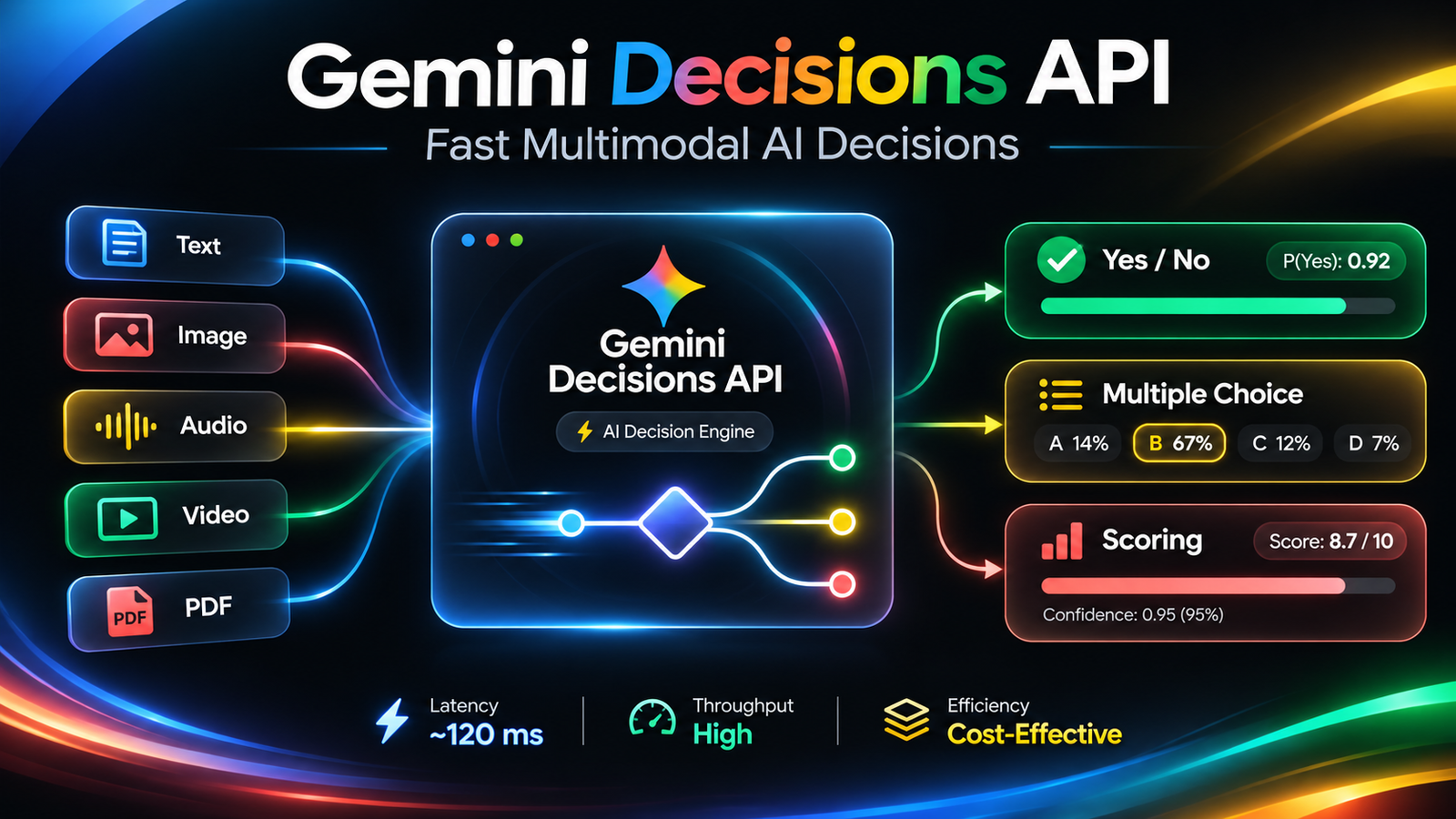
Google has introduced the Gemini Decisions API, a new developer tool designed to make fast, structured AI decisions.
The API runs on Google’s new Gemini Decision 1 model. It focuses on choosing between defined options instead of generating lengthy responses.
Developers can use it for tasks like model routing, content checks, scoring, classification, and automated decision systems.
What is the Gemini Decisions API?
Traditional AI models usually generate answers one token at a time.
Gemini Decisions takes a different approach.
Developers provide an input and a set of possible decisions. Gemini then evaluates those choices and returns probability and confidence scores.
Google says developers can submit up to 1,000 independent questions in one request.
The API supports several input formats, including:
- Text
- Images
- Audio
- Video
- PDF documents
Developers can also combine multiple formats within the same request.
For example, an insurance system could analyze damage photos alongside a scanned claim document.
Gemini Decision 1 focuses on speed
Speed is one of Google’s biggest selling points.
Google says Gemini Decision 1 can deliver approximately 150 to 250 milliseconds of end-to-end latency.
Instead of generating full responses, the model scores predefined choices in a single processing pass.
That could make it useful for applications where decisions must happen almost instantly.
Think of customer support routing, fraud checks, moderation systems, or selecting the right AI model.
Three types of decisions
The API currently supports three main decision formats.
Yes or No
Developers can ask whether a particular condition exists and receive a confidence score.
Multiple Choice
The model can select between two and 255 available options.
It also provides probabilities for each option.
Scoring
Developers can create an ordered scoring system and let Gemini evaluate the input against that scale.
These options could make the API useful for workflows that previously required separate classification models.
Google is already using it
Google says several of its own products are already using the Decisions API.
Gemini Notebook uses the technology to decide which model and reasoning level should handle a request.
According to Google, this approach can reduce latency for everyday queries by up to 40%.
Google’s Stitch experiment also uses the API for rapid interface design.
Another Google Labs project uses it to select emoji reactions from more than 200 choices.
Google Search is also using the technology as a safety layer for certain MCP tool interactions.
How much does it cost?
Google has priced Gemini Decision 1 at $0.10 per one million input tokens.
Google does not charge for output tokens because the model does not generate traditional text responses.
The company also offers a no-cost API tier for developers experimenting through Google AI Studio.
Google says the shared input is billed once, even when developers evaluate several questions against it.
Why this matters
The Gemini Decisions API shows another direction for generative AI.
Not every application needs an AI chatbot that produces paragraphs of text.
Many systems simply need AI to make a fast and reliable choice.
Google is positioning Gemini Decision 1 specifically for those situations.
The low pricing and multimodal support could also make it attractive for developers building AI agents and automated workflows.
Integrations with platforms including LangChain, OpenRouter, Vercel AI SDK and LiteLLM are also rolling out.
For developers, the bigger question will be how consistently those confidence scores perform outside Google’s own benchmarks.
For now, Gemini Decisions gives Google another specialized tool in the growing AI developer ecosystem.