
Etsy is making another major change to its business, and this time hundreds of employees are affected.
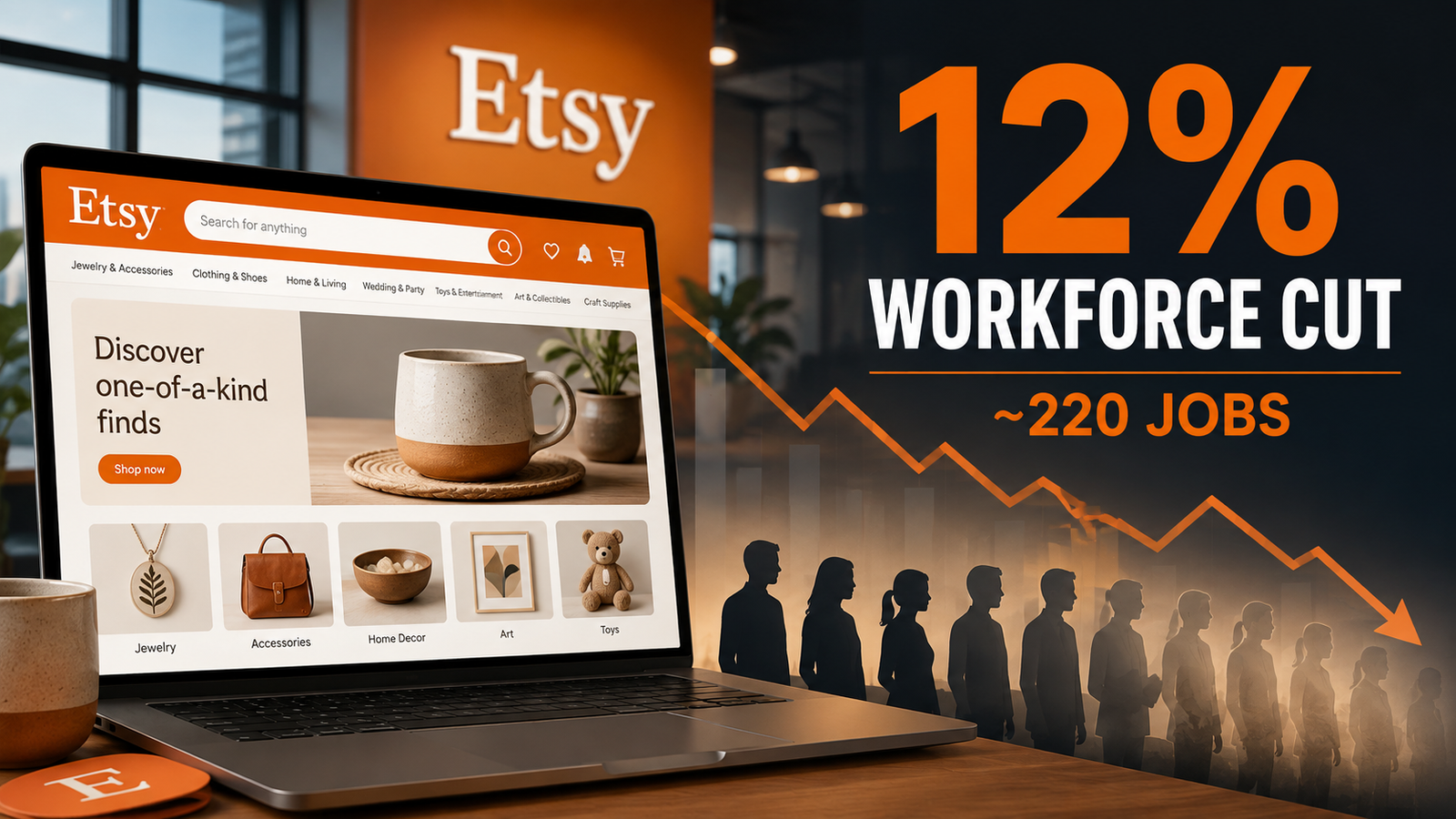
The online marketplace is laying off approximately 220 employees, representing about 12% of its workforce. Most of the cuts will affect Etsy’s product and engineering teams. The company says the restructuring should simplify its organization, improve coordination, and help teams make decisions faster.
However, Etsy says the decision was not primarily about cutting costs. It also pushed back against suggestions that artificial intelligence caused the layoffs.
Why Is Etsy Cutting 12% of Its Workforce?
Etsy CEO Kruti Patel Goyal told employees that the company needs a simpler operating structure as it prepares for its next stage. According to Etsy, cost savings will result from the restructuring, but reducing expenses was not the original goal.
Instead, management wants smaller teams, clearer responsibilities, and faster decision-making across the company. Most of the affected positions sit inside product and engineering, two areas that play a central role in Etsy’s marketplace technology.
Following the layoffs, Etsy is expected to employ roughly 1,600 people. The restructuring should be largely completed by the end of the third quarter. Etsy could also record around $35 million in severance and other restructuring-related expenses.
Etsy Says AI Did Not Cause the Layoffs
With technology companies increasingly using AI to improve productivity, layoffs involving engineering teams naturally raise questions. However, Etsy says AI was not the reason behind these job cuts. Patel Goyal specifically told employees that the changes “weren’t driven by AI.”
At the same time, she acknowledged that artificial intelligence is changing how Etsy employees build products and solve problems. That distinction is important.
Etsy is not claiming AI has no impact on its workforce. Instead, the company says its current restructuring focuses on organizational design and long-term priorities. Employees may still see their roles evolve as AI tools become more deeply integrated into Etsy’s development processes.
Affected Employees Will Receive Severance Support
Employees losing their jobs will receive at least 16 weeks of severance pay. Some workers will receive additional compensation depending on how long they have worked at Etsy.
The company will also provide healthcare support for up to 12 months, along with other transition benefits. For affected workers, the cuts arrive during another difficult year for employment across technology and digital businesses.
Several large companies have reduced staff during 2026 while reorganizing around automation, AI, efficiency, and changing customer demand.
The Layoffs Come Despite Improving Business Results
What makes Etsy’s announcement particularly interesting is its timing. The company reported second-quarter revenue of about $668.3 million, increasing 6.2% from the previous year.
Gross merchandise sales from continuing operations reached approximately $2.58 billion during the quarter. Etsy also raised its annual growth expectations following the stronger quarter.
That means these layoffs do not appear to be a reaction to an immediate financial crisis. Instead, management is restructuring while the company attempts to build momentum and create a leaner organization. Etsy also authorized an additional $2 billion share repurchase program alongside its latest financial results.
Etsy Is Refocusing on Its Core Marketplace
The workforce changes are part of a broader transformation happening inside Etsy. The company recently completed the sale of fashion resale platform Depop to eBay. The transaction closed on July 30.
Etsy had originally acquired Depop in 2021 as it expanded beyond its main marketplace. Selling the business allows Etsy to concentrate more resources on its core platform for handmade, creative, and personalized products.
The company previously sold music marketplace Reverb in 2025. Together, these moves show Etsy becoming a more focused company after several years of expansion.
This Is Not Etsy’s First Major Workforce Reduction
Etsy employees have already experienced a significant restructuring in recent years.
In December 2023, the company announced an approximately 11% workforce reduction affecting around 225 employees. At the time, Etsy said the changes were needed to improve operational efficiency and better align resources with its priorities.
The latest 12% reduction therefore marks another major adjustment in less than three years. However, Etsy’s current leadership is presenting this round differently.
Instead of focusing mainly on expenses, the company is emphasizing speed, coordination, and its ability to build products more effectively.
Why This Matters
Etsy’s restructuring highlights an important shift happening across the technology industry. Companies are increasingly questioning whether large organizational structures still make sense when software development and internal workflows are changing rapidly.
AI adds another layer to that discussion, even when it does not directly cause layoffs. Smaller teams equipped with better software can potentially move faster. However, companies must still maintain product quality, customer support, and innovation.
For Etsy, that balance will be especially important. The company must improve the experience for buyers while supporting millions of independent sellers who depend on its marketplace.
Cutting employees may simplify operations. The harder challenge will be proving that a smaller organization can build a better Etsy.
Our Verdict
Etsy’s decision to cut 12% of its workforce looks less like an emergency cost-cutting measure and more like a broader corporate reset. The company is selling non-core businesses, simplifying internal teams, investing in its main marketplace, and returning capital to shareholders.
Meanwhile, Etsy insists that AI did not trigger the layoffs, even though the technology will continue changing how its employees work. That makes the next few quarters especially important.
If Etsy can accelerate product development and improve its marketplace after the restructuring, management’s strategy could start showing results. If growth fails to follow, however, another large workforce reduction will become much harder to explain.




Amazing vibes and a huge selection of games. It feels just like being at a real casino from my living room. See you all at vn88vvkazino!
The game selection is top notch. I spend most of my free time exploring the slots on q98game.
If you are looking for a platform that actually pays out and has a wide range of slots, bigobet889 is the way to go.
[3466]hk88 | Link vào nhà cái chính thức và hướng dẫn chơi baccarat,Truy cập hk88 để tải app hk88 nhanh chóng và khám phá kinh nghiệm quay slot nổ hũ dễ thắng. Hỗ trợ nạp tiền qua momo casino tiện lợi. Tham gia ngay! visit: hk88
I’ve been trying a few platforms lately and this one really stands out for its speed. Everything is smooth and easy to navigate. Definitely worth checking out ug234
I’ve been trying out a few sites lately and this one really stands out. The interface is smooth and the payouts are surprisingly fast. Highly recommend checking out ph878ph if you want a reliable spot.
The graphics are great and the gameplay is very exciting. Definitely one of the best platforms out there phtaya7774.