
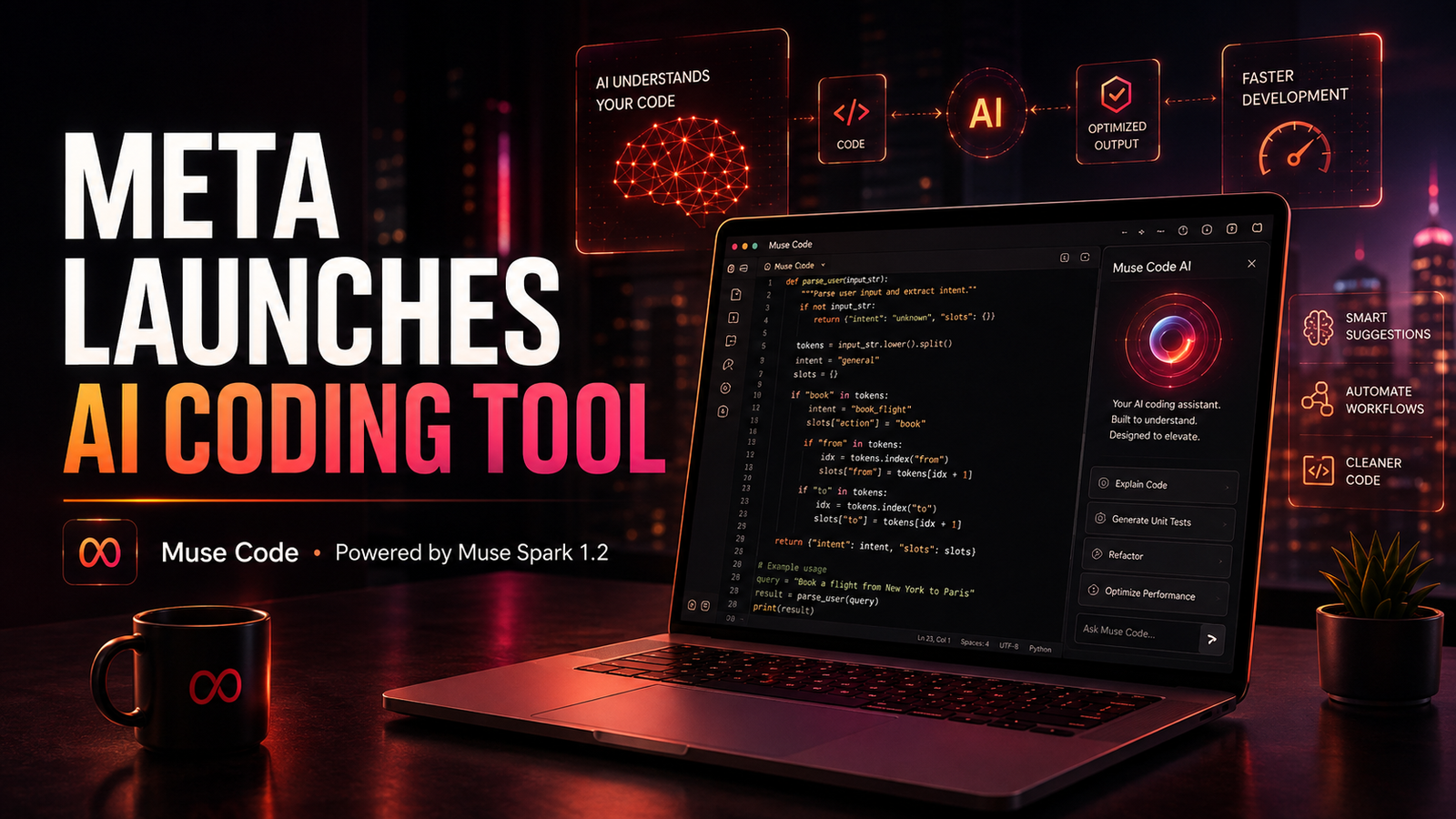
Meta is stepping deeper into the AI coding race with Muse Code, a new coding agent designed for complex software development.
The company launched Muse Code in beta on August 5. It runs on Muse Spark 1.2, Meta’s newest coding-focused artificial intelligence model. Unlike basic coding assistants that mainly suggest snippets, Muse Code can plan changes, write code, verify results, and work across large repositories.
The launch puts Meta into more direct competition with developer tools from OpenAI and Anthropic. It also signals Meta’s growing effort to turn its AI research into developer-focused products.
What Is Meta Muse Code?
Muse Code is a terminal-based AI coding agent built by Meta Superintelligence Labs.
Developers can give it larger software engineering tasks instead of requesting individual lines of code. The agent can then plan the work and execute multiple steps. Meta says Muse Code can handle repository-wide projects, write new code, understand existing codebases, debug problems, and validate its results.
It can also coordinate several specialized AI sub-agents while completing a project. That approach could make Muse Code more useful for complicated development work where several parts of a project need attention simultaneously.
Multiple AI Agents Can Work Together
One of Muse Code’s most interesting features is its use of persistent background agents. These specialized agents remain active throughout a development session. They can gather information and complete supporting tasks for the main agent.
That differs from systems that create a new agent every time another task appears. Meta says keeping those agents active reduces repeated work and can improve performance during difficult, multi-step projects.
This could become particularly useful when developers work with large applications containing thousands of files and several connected services.
Muse Code Can Resume After a Crash
Meta has also designed Muse Code with longer development tasks in mind. The system maintains a local event log containing model calls, tool executions, approvals, edits, and other actions.
If the coding environment crashes, Muse Code can use that record to continue from where it stopped. Developers would not necessarily need to restart an entire long-running AI task after a failure.
That feature could prove important as coding agents move beyond short prompts toward projects that run for hours.
Muse Spark 1.2 Powers the New Coding Agent
Behind Muse Code is Muse Spark 1.2, an updated version of Meta’s recently launched Muse Spark AI family. Meta describes Spark 1.2 as a coding-focused upgrade with improvements in code generation, debugging, codebase understanding, and complete development workflows.
The company increased the amount of training compute dedicated to coding tasks while also expanding the variety of training environments. Meta also trained Muse Spark 1.2 and Muse Code together.
According to Meta, that co-training helps the model work more effectively with Muse Code’s tools and agent architecture. Muse Spark 1.2 follows Muse Spark 1.1, which Meta opened to developers in July through its Meta Model API.
Meta Built It for Long Coding Projects
AI coding tools are increasingly moving beyond autocomplete. Companies now want AI agents capable of understanding an entire project, planning changes, using development tools, and completing tasks with less supervision.
Meta says Muse Spark 1.2 received extensive training for these longer workflows. That includes whole-repository generation, end-to-end software projects, research tasks, planning, and maintaining context during extended workloads.
Meta even tested the model on GPU optimization tasks involving more than 1,000 tool calls during runs lasting up to 24 hours. These tests do not guarantee identical results in everyday development. However, they show the type of workload Meta expects the system to handle.
How Much Does Muse Code Cost?
Meta is offering Muse Code in beta alongside access to Muse Spark 1.2 through the Meta Model API.
According to Reuters, Meta’s standard pay-as-you-go pricing is $1.25 per million input tokens and $4.25 per million output tokens. Pricing could become an important part of Meta’s strategy.
AI coding agents can consume large numbers of tokens when analyzing repositories, debugging software, or running autonomous tasks. Lower model costs could therefore attract developers experimenting with AI-powered software development at scale.
Muse Code Currently Supports macOS and Linux
Meta provides a command-line installation option for Muse Code. The beta currently supports macOS and Linux, according to Meta’s launch documentation.
Its terminal-first approach also positions Muse Code more as a professional development tool than a traditional chatbot. Developers can work with the agent directly inside environments already used for software development.
Meta Is Entering an Already Competitive Market
Meta is arriving in a crowded AI coding market. OpenAI and Anthropic have already been aggressively developing tools capable of writing software and completing multi-step programming tasks.
Meta now appears determined to become another major player. The company first introduced Muse Spark in April. It followed with Muse Spark 1.1 and a public developer API in July. Muse Code represents the next stage of that strategy by pairing Meta’s model with a dedicated software engineering agent.
Why This Matters
AI coding is quickly becoming one of the most important commercial applications for generative AI.
Developers are no longer using these systems only to generate small functions. Newer agents can increasingly investigate bugs, modify projects, test changes, and coordinate larger workflows. Muse Code gives developers another major option in that rapidly expanding market.
More importantly, Meta is combining its AI models with a complete coding environment rather than offering only an API. If Muse Code proves reliable on real-world projects, competition between Meta, OpenAI, Anthropic, and other AI companies could intensify.
That competition could eventually mean better coding agents, lower prices, and more choices for developers.
For Meta, Muse Code also represents something bigger. The company is showing that its latest AI push is not limited to Facebook, Instagram, WhatsApp, or consumer assistants.
Meta now wants a serious position inside the tools developers use to build software.




[7639]Magius | Link Vào Chính Thức – Casino Trực Tuyến Uy Tín Số 1,Magius cung cấp link vào chính thức cùng hướng dẫn tải app APK nhanh chóng. Trải nghiệm baccarat online hấp dẫn và nạp tiền tiện lợi qua ví Momo. Tham gia ngay! visit: magius
The installation was a breeze and the login process is secure. I love how everything is just a click away with 93jililoginappapk
Everything is just spot on. From the loading speeds to the overall design, it is just perfect. brwww444 is a gem of a site for anyone who loves online gaming.
The VIP perks here are actually worth it. I feel valued as a player and the bonuses are generous. Check out br222vip for a premium experience.
The graphics and sound effects on this site are amazing. It feels like I am in a real casino from the comfort of my home. xx777casino is legit!
Just wanted to share how much I enjoy playing here lately. The navigation is super simple and I never have to wait long to cash out. Definitely one of the most trustworthy spots I have tried so far. mymudahking
Finally found a login link that actually works without any redirects. Great service and the support team is very responsive. Give nibung88login a try.
One of the best platforms I have used recently. Everything is straightforward and the graphics are top notch. Go for idasiabet